
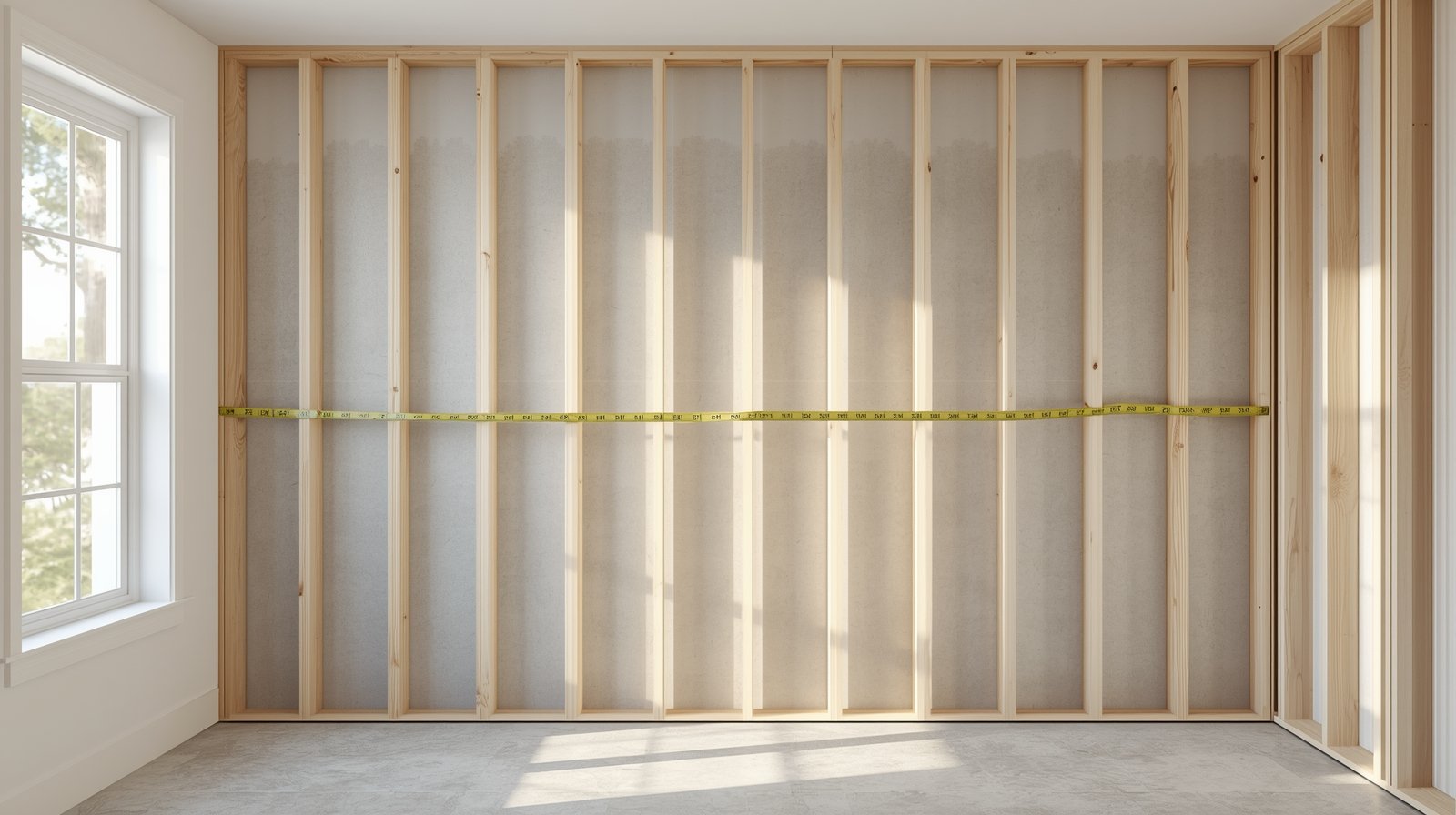
How far apart are studs in the wall? It’s one of those questions some people ask when they’re hanging a TV, installing shelves, or doing any number of home improvement projects. Walls appear to be monolithic and solid, but in reality, there’s a framing system behind that drywall that adheres to particular spacing rules. Knowing this spacing will not only prevent costly mistakes, but it can also save you from unnecessary cracks or weak points in your drywall.
Unless you’re redecorating or remodeling professionally, few people spend any time figuring out how stud spacing works. Let’s go through it in plain language, step by step, like you’re getting this from a friendly buddy who’s done this a few times.
What Are Wall Studs and Why Do They Matter
Wall studs are the vertical wooden (sometimes metal) members in a wall. They make up the skeleton of a wall, and bear the weight of drywall, cabinets, shelves, doors, and in some houses, parts of the roof or upper floor.
Studs are necessary because drywall by itself would not be able to support much weight. The load passes directly through the drywall and places extra stress on the surrounding area. If you screw or nail to a stud, then the load can pass into the structure of the wall, where it is safe, rather than stressing your drywall.
This is why stud spacing isn’t random. In construction, builders use common dimensions to create strong, safe, and consistent structures.
How Far Apart Are Studs in the Wall (Standard Spacing)
Studs are typically spaced 16 inches from center to center in most residential buildings. That is called 16 inches on center (represented as “16″ OC”).
That is, if you measure from the middle of one stud to the middle of the next, you get 16 inches.
That spacing is now the norm because it offers a balance of strength, efficiency in material, and compatibility with drywall sheets that are generally 48 inches wide. At 16-inch spacing, the edge of a piece of drywall falls nicely on top of a stud.
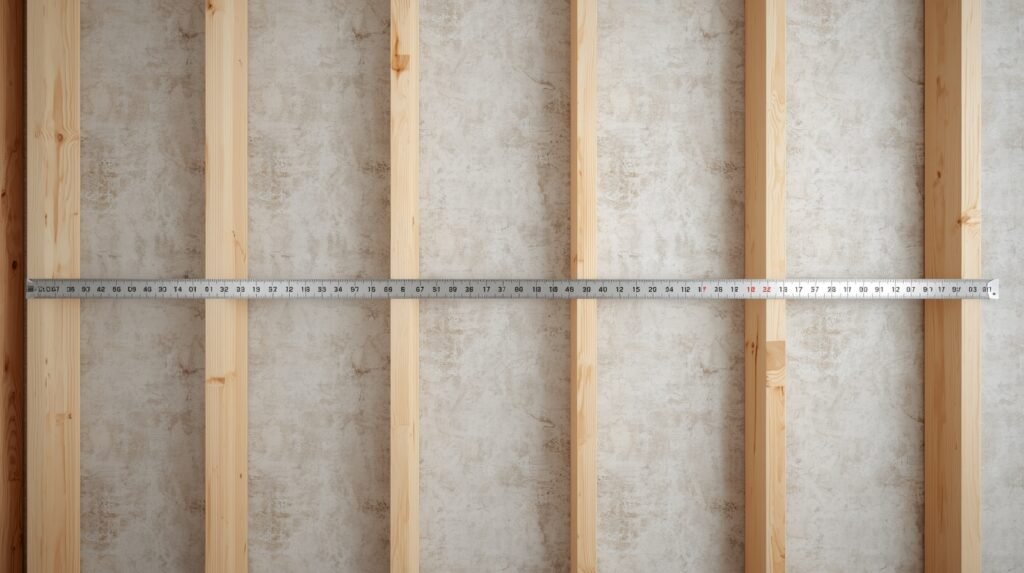
Other Common Stud Spacing You May Encounter
Anyway, studs in a wall are typically spaced 16 inches apart—that’s the standard. But it’s not your only option!
24 Inches on Center
Some homes are built 24 inches on center, especially newer or energy-efficient builds. Studs are therefore more widely spaced, using less lumber.
This gap is commonly used on thicker drywall and engineered wall systems. And while 24-inch spacing will clear building codes in most of the country, walls with 24-inch spacing may feel slightly less strong.
12 Inches on Center
12″ o.c. is used rarer still. This closer spacing is typically used in load-bearing walls, for extra strength, or with denser building material or older construction.
You might also find this spacing around windows, doors, or other large structural elements.
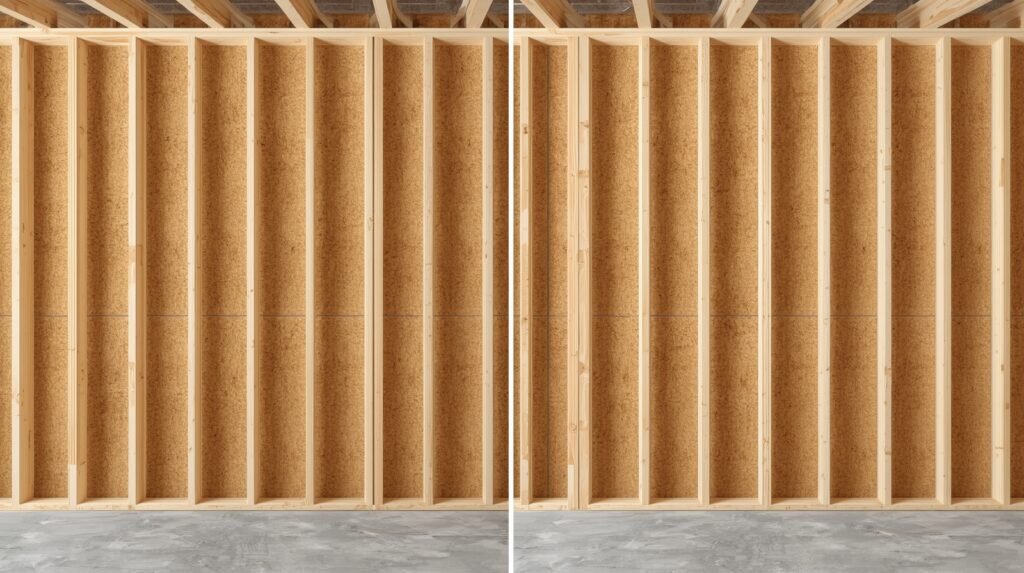
Why Stud Spacing Is Measured From the Center
Just remember! Studs are always measured from center to center—i.e., so your wall width between the studs should be slightly less than 16′. This method keeps measurements consistent regardless of stud width.
For instance, most wood studs measure approximately 1.5 inches wide. Center-to-center measurement provides an accurate and easy way to install, and as long as studs vary within the least (slender) part of the range, drywall or other project materials will fit perfectly.
Builders use this system to ensure that all parts fit as expected during construction.
How to Find Studs Based on Their Spacing
Finding them is that much simpler once you know how far apart the studs in the wall typically are.
Another common trick is to find one stud, then measure 16 inches to the left or right for the next. The vast majority of the time, you will hit another stud precisely where you thought it would be.
Some people start getting the studs near an electrical outlet. Outlets are generally installed on the side of a stud, which provides you with sturdy placement to kick things off.
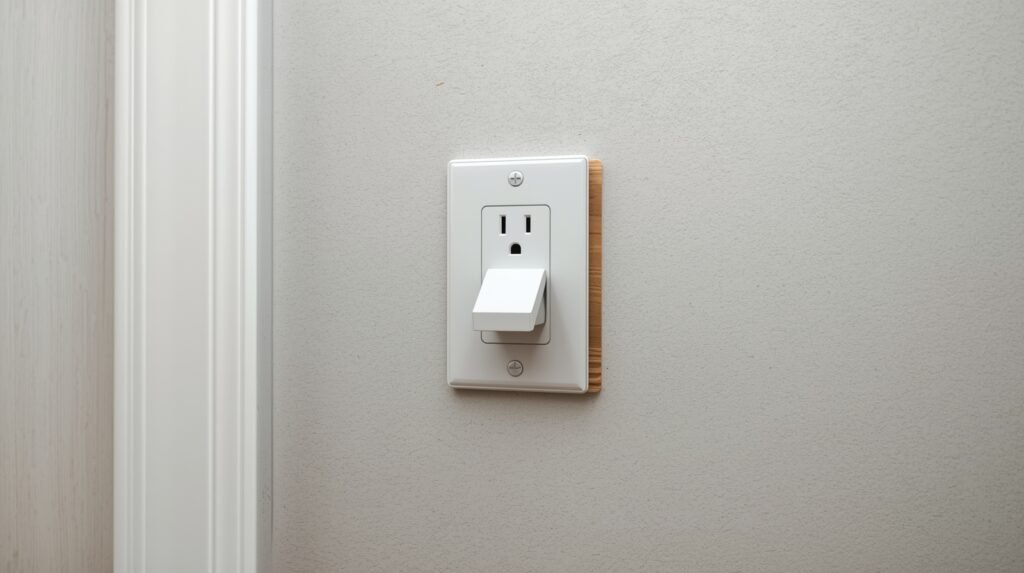
And, anecdotally, plenty of DIYers have found that out the hard way by drilling multiple holes before discovering they were just an inch or two off from finding the stud.
Does Stud Spacing Change in Different Walls?
Yes, stud spacing can be different according to what the wall will be used for.
Load-Bearing Walls
Those load-bearing walls might have more or closer-spaced studs to carry weight from floors above. Though they may continue to be spaced 16 inches apart, subsequent framing is often added.
Interior vs. Exterior Walls
Occasionally, tighter on-center or thicker studs are used for an exterior wall assembly to provide additional insulation and strength. Interior walls are more likely to adhere closely to standard spacing. Stud spacing also affects energy efficiency, especially when installing insulation in walls in interior and exterior assemblies.
Older Homes
In older homes, studs may not be spaced evenly. In some older homes, rough spacing was used that doesn’t adhere to modern standards, making it more difficult to locate studs.
Stud Spacing and Drywall Installation
Drywall size plays a big role in why stud spacing exists.
Typical Drywall Panels are four feet wide. With 16-inch spacing, the edges of drywall sheets neatly hit studs at 0, 16, 32, and 48 inches. This provides for a faster, stronger installation.
Had studs been put in at random intervals, the drywall joints would be that much weaker and subject to cracking over time.
Metal Studs vs. Wood Studs Spacing
Metal studs, the kind you’ll find in most commercial buildings and some residential interiors, tend to follow a similar order when it comes to spacing.
You will still encounter 16 inches on center most frequently, with a handful of designs employing 24 inches. The difference comes when you’re drilling, and what it feels like to do so — the metal studs are thin, and don’t snatch screws as they would with wood.
Spacing, however, usually stays consistent.
Why Knowing Stud Spacing Helps With DIY Projects
Understanding how far apart studs in the wall are can prevent several common problems. Proper planning is especially important when working around an awkward living room layout with fireplace.
It helps you:
- Mount heavy items securely
- Avoid unnecessary wall damage
- Plan layouts accurately
- Work faster with fewer mistakes
Many people remember the first time they mounted a shelf without hitting a stud. It usually ends with anchors pulling out and a quick lesson in why stud spacing matters. Knowing where studs are located is especially helpful when installing extra large wall mirrors for living room.
Common Misconceptions About Stud Spacing
One persistent myth is that studs are always spaced exactly 16 inches apart, no matter what. The pattern is interrupted by the reality of objects such as windows, doors, and corners.
Also, people tend to think that all homes have the same stud spacing. There is some latitude in code, and older homes don’t always meet current standards.
That’s why it is always smarter to measure and confirm than to guess.
Final Thoughts
The question then becomes: How far apart are studs in the wall? For the biggest, most fat screw-driven job of all, clapping up ceiling drywall to overhead joists, the response is typically 16 inches on center, although there are odd-man-out exceptions like 24 inches or 12 inches, depending on construction type, age, and structural demand.
Having this simple fact in your back pocket makes you more confident working on walls, whether it’s hanging a picture or pulling off something bigger. It makes a secret area of your home into something consistent and comprehensible, which is what good home knowledge should feel like.