
Why This Problem Almost Always Starts After Dark
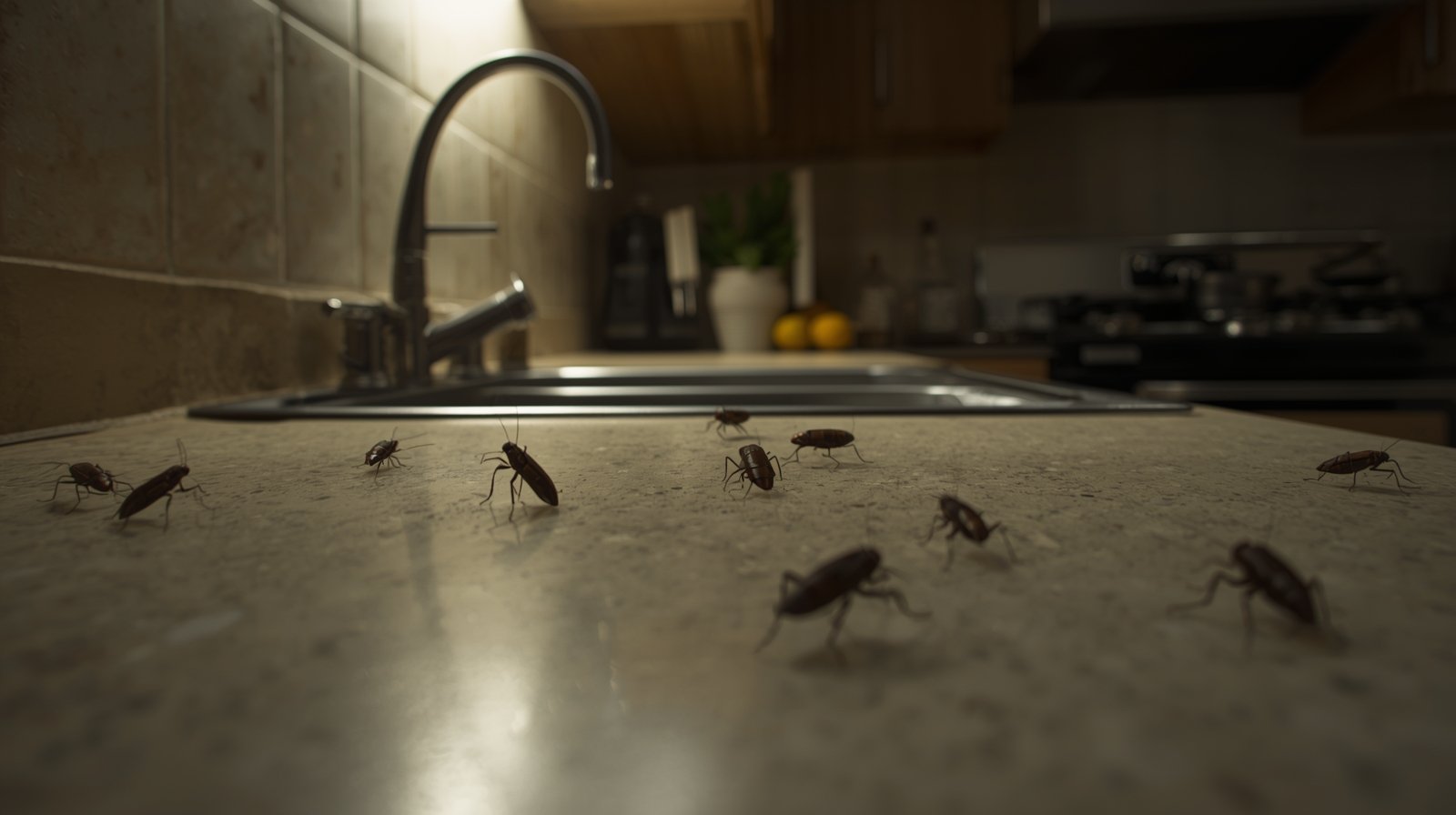
If you’ve noticed small cockroaches in kitchen at night, you’re seeing a pattern that millions of households experience but rarely understand fully. It often happens quietly. You stumble into the kitchen in your pajamas to get a glass of water and flip on the light switch, only to be greeted by dozens of tiny roaches skittering across your countertop or sink, or even worse, scurrying around on the floor.
By day, the kitchen appears normal. Quiet. Almost innocent. At night, it feels like a different room.
Understanding What “Small Cockroaches” Usually Means
When folks report seeing tiny roaches, they usually mean to say German cockroach, not baby roach of a larger species. Some homeowners also confuse them with small bugs mistaken for roaches.
These cockroaches:
- Are light brown or tan
- It has two dark stripes behind the head
- Are fast and agile
- Adults are about ⅜ to ⅝-inch. Measure about 3/8- to 5/8-inch.
They’re small, difficult to detect, and underestimated.
If you spot small cockroaches in kitchen at night, it’s almost a given that they are an indoor-adapted species, rather than an outdoor one.
Why Cockroaches Are Active Almost Exclusively at Night
Cockroaches were adapted to one way of life: stay out of the way of predators, light, and disturbance. This pattern aligns closely with the nocturnal behavior of cockroaches documented by entomology researchers. Darkness gives them safety.
At night:
- Human activity drops
- Kitchens are quiet
- The lights are off
- Food residue is undisturbed
- Moisture remains from sinks and dishwashers
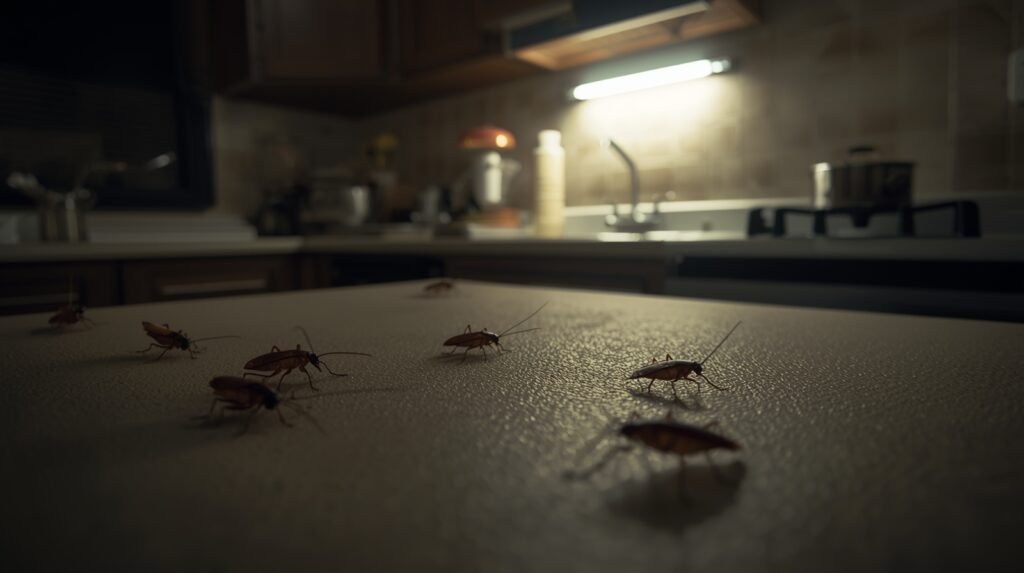
This is why small cockroaches in kitchen at night appear suddenly when the lights turn on. They’re not appearing; they were already there.
A homeowner once described it perfectly: “It felt like the kitchen woke up before I did.”
Why the Kitchen Becomes Their Primary Target
Cockroaches don’t wander randomly. They stay close to resources.
The kitchen offers:
- Constant food availability
- Moisture from plumbing
- Warmth from appliances
- Tight hiding spaces
Even microscopic food residue, like grease vapor behind a stove, is enough to sustain them.
This is why small cockroaches in kitchen at night are far more common than sightings in bedrooms or living rooms.
How They Enter the Kitchen Without You Realizing
Cockroaches don’t need open doors or dirty conditions. Common entry paths include:
- Grocery bags and cardboard boxes
- Used appliances
- Plumbing lines from neighboring units
- Wall voids shared in apartments
- Small cracks around cabinets and baseboards
In many cases, the infestation didn’t start inside your home; it migrated.
The Real Reason You Don’t See Them During the Day
Daytime invisibility is not a coincidence. Cockroaches are experts at compression and concealment.
They hide:
- Behind refrigerator motors
- Under the stove insulation
- Inside cabinet joints
- Around sink plumbing
- Inside wall gaps are smaller than a dime
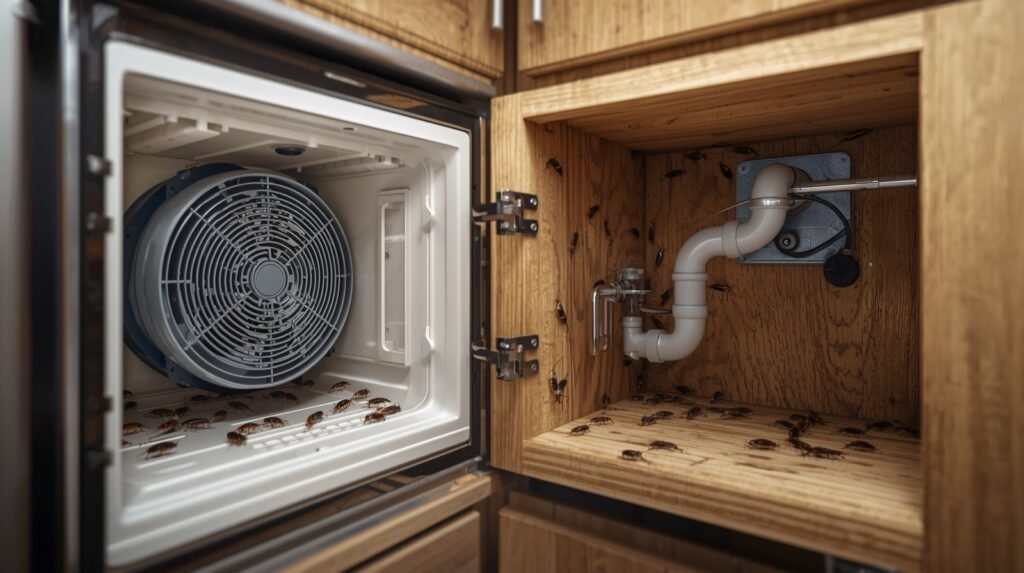
This is why seeing small cockroaches in kitchen at night often feels sudden, even though they’ve been present for weeks.
What Nighttime Sightings Actually Indicate
One roach doesn’t always mean a serious issue. Repeated sightings do.
Frequent small cockroaches in kitchen at night usually indicate:
- An established nesting area nearby
- Consistent food access
- Ongoing moisture sources
- A stable environment for reproduction
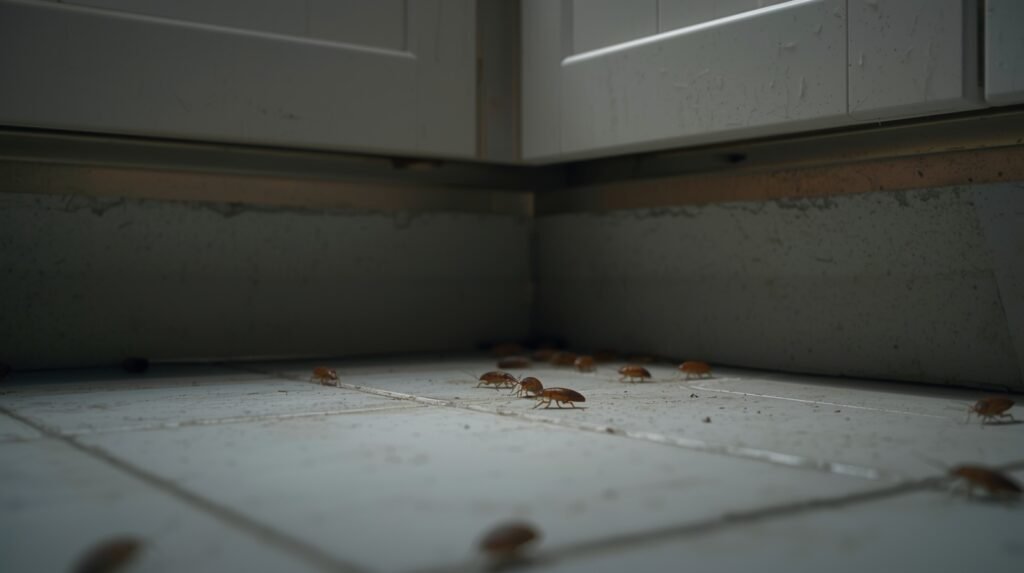
Roaches don’t explore unless survival conditions are already met.
Learning Their Reproduction Cycle (Why They Multiply Fast)
Humping factor: German cockroaches breed faster than most people would think.
Key facts:
- Up to 40 eggs at a time are carried by a single female
- Eggs hatch in about 28 days
- Nymphs mature quickly
- Multiple generations overlap
This explains why sightings can escalate from “occasional” to “nightly” within a short period.
Why Clean Homes Still Experience This Problem
Cleanliness helps, but it doesn’t eliminate structural vulnerabilities.
Even spotless kitchens can attract roaches due to:
- Condensation under refrigerators
- Tiny plumbing leaks
- Warm appliance motors
- Shared walls in multi-unit buildings
Seeing small cockroaches in kitchen at night does not reflect personal hygiene. It reflects environmental opportunity.
Subtle Signs Most People Miss
Roaches don’t always announce themselves visibly.
Hidden indicators include:
- Tiny black specks (droppings)
- Musty odor in cabinets
- Smear marks along corners
- Shed skins near appliances
- Increased sightings during quiet hours
If these signs accompany nighttime sightings, activity is established.
Why They Scatter When Lights Turn On
This behavior isn’t panic, it’s instinct.
Sudden light:
- Signals danger
- Triggers escape response
- Sends roaches back to the shelter
The faster they scatter, the closer their hiding spots are.
That’s an important behavioral sign most people miss.
Emotional Effect: Why This Is So Frightening
Roach sightings feel invasive. Kitchens are personal spaces tied to food and family.
People often feel:
- Embarrassed
- Anxious
- Frustrated
- Overwhelmed
Those reactions are human. But knowledge replaces fear with clarity.
Knowing small cockroaches in kitchen at night takes away the mystery, and mystery is what stress thrives on.
Common Mistakes that Help Wind the Spring Tighter
Many well-intended actions backfire.
Mistakes include:
- Spraying randomly without locating nests
- Killing visible roaches only
- Ignoring moisture sources
- Leaving pet food overnight
- Using multiple products inconsistently
Short-term action without strategy creates false confidence.
Why Nighttime Is the Best Time to Observe Activity
If you want accurate insight, observe quietly at night.
Helpful steps:
- Turn on the lights slowly
- Note movement paths
- Watch where they retreat
- Identify recurring zones
This information is more valuable than any single spray.
Environmental Factors That Increase Night Activity
Certain conditions amplify nighttime sightings:
- High humidity
- Warm weather
- Recent rainfall
- Seasonal transitions
- Plumbing changes
These factors push roaches deeper indoors, especially into kitchens.
Why Apartments Experience This More Often
Shared structures create shared problems.
In apartments:
- Roaches move through walls
- One unit affects others
- Treatment must be coordinated
- Kitchens share plumbing lines
Seeing small cockroaches in kitchen at night in an apartment does not mean the source is yours alone.
Long-Term Perspective: Why Ignoring It Rarely Works
Roaches don’t leave voluntarily.
Without environmental change:
- Food remains available
- Moisture persists
- Shelter stays intact
- Reproduction continues
Time alone never solves the issue.
Understanding the Difference Between Occasional and Persistent Sightings
Occasional:
- One roach every few weeks
- No visible signs
- No patterns
Persistent:
- Multiple roaches
- Nightly activity
- Same locations
- Increasing frequency
Persistent small cockroaches in kitchen at night always deserve attention.
Why This Issue Is So Common in Modern Homes
Modern kitchens unintentionally support roach survival:
- Tight cabinetry
- Insulated appliances
- Continuous heat sources
- Water-saving fixtures that still leak slowly
Efficiency for humans often means comfort for pests.
Key Facts to Remember
- Cockroaches are nocturnal by nature
- Kitchens provide ideal survival conditions
- Night sightings reflect hiding proximity
- Cleanliness helps, but isn’t the whole answer
- Awareness is more powerful than panic
Final Thoughts: Replacing Fear With Understanding
It’s unsettling to see small cockroaches in kitchen at night, but it’s not a personal failing or a mystery. It’s a biological reaction to environment, timing, and opportunity.
When you know why they seem to be at night and what the behavior is all about, things are then very manageable and logical and much less scary.
Knowledge is not only enlightening; it’s empowering.