
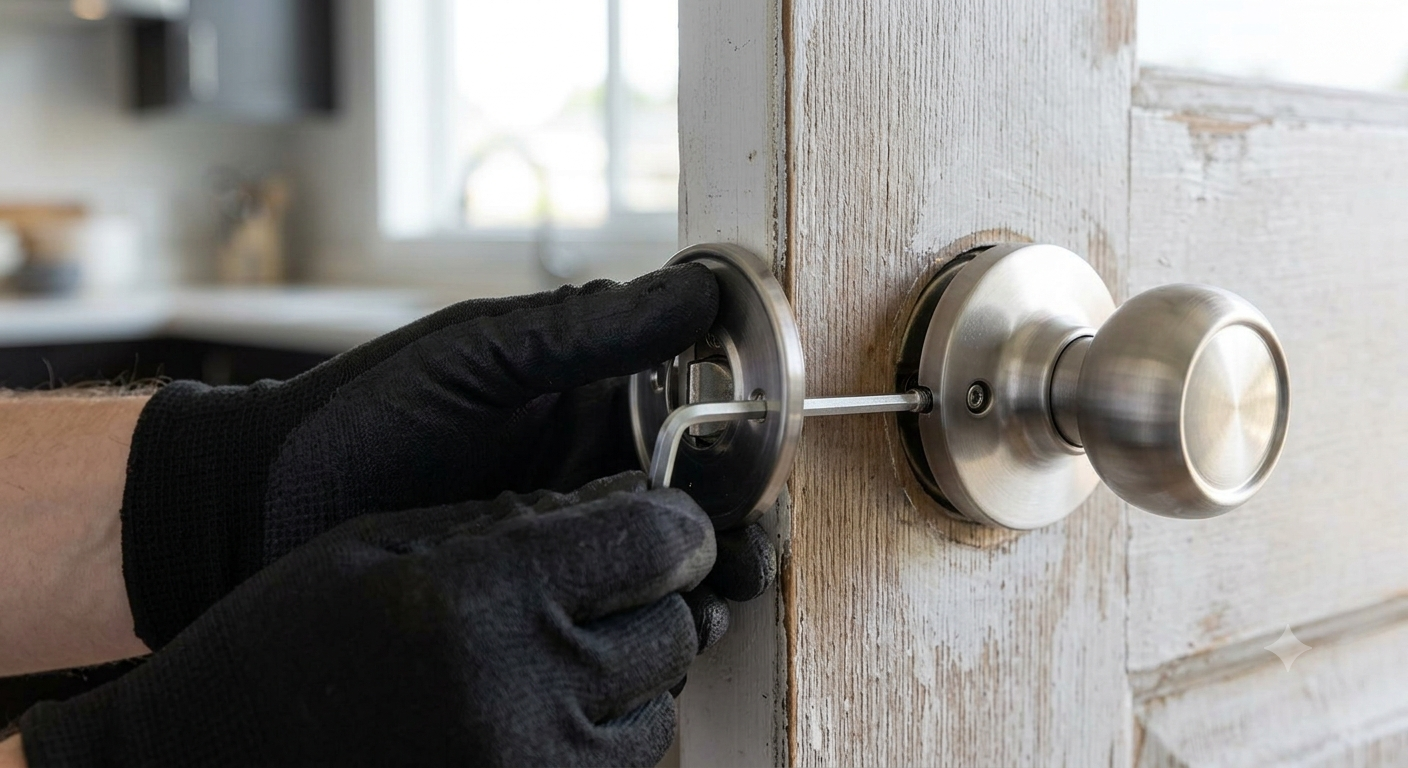
A loose doorknob can be a small nuisance that is easy to ignore, but if not dealt with, it will become a major headache. Whether it wobbles when opened or turned, spins uselessly when it should engage the locking mechanism, or even feels like it might come completely off in your hand, fixing it is a good idea. Fortunately, learning how to fix loose doorknob problems does not require advanced carpentry skills. In many cases, a basic screwdriver and a few minutes of careful work are enough to restore the hardware to its proper condition.Fixing a loose doorknob typically requires only a screwdriver and some patience.
Doorknobs are used constantly throughout the day, meaning that they are subject to more stress than most other house fixtures. It’s inevitable that after several months or even years of near-constant use, the screws will begin to loosen, the door itself may warp slightly, and the hardware will begin to give. These are some of the reasons why understanding the cause of the loose doorknob is important to finding the right solution
Why Do Doorknobs Become Loose?
Getting the Knob Right You should figure out what is causing your knob to be unsteady before starting to fix it. When you fix an unsteady doorknob, there are usually several mechanical reasons it will cause problems that don’t indicate hardware failure. When you move a doorknob repeatedly you use a slight pressure and can put slight stress onto the mounting hardware, it could also cause a handle to come a little loose because the mounting screws wear out from constant use over years or decades; however, you could see even more common reasons a doorknob might become shaky.
One common reason: Hardware aging is often reason enough to cause a door knob to feel loose.
Internal pieces of a modern doorknob turn the latch, that mechanism will likely be a complex metal piece that wears away over years of use. An aging, door frame expanding due to humidity is a potential cause; it could possibly push it on and off because it can alter the placement in relation to where a doorknob goes and it would possibly make a knob become loose in relation to how tight the screws are; or on occasion, a doorknob could become loose by another’s DIY efforts such as incorrectly fitting parts, to an inordinate amount of tightness on any of the screws or the assembly of it.
Understanding How a Standard Doorknob Works
Understanding the basic components of a doorknob will make solving problems with the unit easier. In most houses, the doorknob has two handles that are attached together on either side of the door by a rod or spindle. The two sides of the knob attach together with mounting screws that are concealed underneath a cover plate or exposed on the side that you are using to enter or exit.
Turning the knob turns the rod that operates the latch that holds the door shut.
Turning the knob retracts the latch and allows the door to open. If the components that hold the knobs together become loose, then your knob may be unstable or will turn ineffectively or spin.
The primary components include:
| Component | Purpose |
| Interior knob | Used to operate the latch from inside |
| Exterior knob | Opens the door from the opposite side |
| Mounting screws | Hold both halves tightly together |
| Latch assembly | Extends and retracts the latch bolt |
| Spindle or shaft | Transfers turning motion between both knobs |
| Strike plate | Receives the latch when the door closes |
Understanding these parts helps identify exactly where the looseness originates when learning how to fix loose doorknob issues.
Tools You May Need
Another common factor in this project’s ease of completion by DIYers is the low level of required tools. Collect all necessary equipment prior to beginning the project so your work will proceed smoothly. Tools you’ll want are likely a Phillips-head screwdriver, since many knobs utilize Phillips screws, and some new models incorporate flat-head screws, and top-of-the-line hardware may feature a standard Allen set screw (or hex screw), which often needs a tiny version of this tool to be loosened or tightened..
A flashlight is also helpful for illuminating hard-to-reach screws that may be hidden beneath trim or decorative covers.
For easy cleanup between the hardware’s reinstallation, you’ll want to pick up a clean cloth for whisking away dust and debris. The availability of the right tool eliminates much of the risk of scratching finishes or damaging screws.
Inspect the Doorknob Before Tightening Anything
A common mistake many people make is to just crank all of the accessible screws down. This will sometimes resolve the problem, but it can mask much deeper damage to the inner working.
First, grasp the knob with your hand on both sides, and try to rock the knob and then rotate it to see if you feel any play. It’s also worth noting if it’s loose when the knob is being turned as well as when it’s sitting still.
Check the plate that’s affixed to the door with your screws. If any of them appear to have been slightly turned outward, then those are the reason your knob wobbles. If there are no exposed screws, you have a knob that is mounted behind a decorative cover that has to be removed.
Finally, check to see if the latch pulls and retacts fully. If the knob isn’t tight, but the latch doesn’t come fully back to your hand then you may have a fault in the latch itself.
Taking just a minute to analyze the problem can lead to a much quicker and more effective fix to your doorknob.
Step-by-Step Guide on How to Fix Loose Doorknob
Once you have identified the cause of the problem, you can begin the repair. Work carefully and avoid using excessive force, as many doorknob components are designed to fit snugly rather than tightly compressed.
Tighten Visible Mounting Screws
Repair Exposed Doorknob Screws – In the case of a doorknob that has visible screws on the interior or exterior sides of the hardware, the repair will typically be straightforward. Align both sides of the doorknob carefully, then tighten each screw a little at a time in an alternating pattern until they are all securely snug. This method avoids any potential damage, such as hardware that may rest awkwardly upon the door. In the event that the doorknob no longer is loose and operates appropriately with the latch, the fix will have concluded.
Remove the Decorative Cover Plate
Concealed Hardware Most new doorknobs have a small ornamental trim cover to hide the mounting screws underneath. You’ll know your hardware is concealable when you don’t see any screws. To reveal them, look for the small notch around the outside perimeter of the decorative cover, place a flat-head screwdriver in it and gently pry upward to remove the trim cover.
Now the screws are accessible.
Turn in on a little for each screw, being careful not to over-tighten. Snap the cover back on place.
Tighten a Loose Set Screw
This involves using an Allen wrench instead of the more conventional screws. Such an Allen screw can normally be found at the bottom of the lever handle and must be removed. Replace it by the appropriate size wrench and screw it in until the handle no longer wiggles.
Do not over-tighten, for that can ruin the threads or the spindle.
If the handle is still not rigid after this, try to discover if the spindle is bent or worn.
Replace Damaged Parts
Replacing Damaged Hardware Sometimes even tightening screws can’t fix the latch problem. If your spindle has become bent, the latch is sticking in place due to an issue within the latch mechanism or the hardware has become worn out from years of use, it may be best to just replace the individual parts. Most companies that manufacture doorknobs offer replacement latch mechanisms, mounting hardware and spindle kits that will work as replacement parts.
If you are unable to find the replacement parts, then usually it’s easier and faster to simply purchase an entirely new doorknob and replace the old hardware.
Ensure that when you install your new knob, that you have installed the knob according to the instructions in order to have the smoothest movement of your latch.
Common Mistakes to Avoid
The most common reasons doorknobs break are the result of a mistake, not complex mechanical issues. One such error is to over-tighten door hardware screws. Homeowners may believe more is better for extra security, but this can damage screw holes, crack the decorative housing, or bend the mounting plate.
Other mistakes include neglecting old mechanisms that are worn beyond repair; the latch will loosen again no matter how tight the screws become.
Door hardware failure is also often blamed on misalignment. If a door is off-kilter, the latch and mounting pieces are subject to continual stress, and will become loose. Using the wrong screws-either too short or too big for the threading-can also cause problems.
Preventing Future Doorknob Problems
Learning how to fix loose doorknob issues is valuable, but preventing them from happening again is even better.
Check high-traffic doorknobs like front, bedroom, and bathroom every few months to tighten screws before they are visibly wobbly. This will help reduce additional wear on the hardware. Keep the latch mechanism clean of dust accumulation.
Lubricate moving parts with a small amount of dry lubricant as recommended by the door manufacturer, not heavy grease or oil.
Try not to let children or even adults abuse the doorknob by hanging or pulling on the lever excessively. Many door hardware pieces wear out quickly from mistreatment. For houses that undergo significant shifts in indoor humidity with the seasons, watch wooden doors for swelling and shrinking. Such shifts can cause door hardware to shift out of alignment.
When Should You Replace Instead of Repair?
Although most loose doorknobs can be repaired, replacement sometimes makes more sense.
Consider installing a new doorknob if:
- The internal locking mechanism no longer functions reliably.
- The spindle or internal gears are broken.
- Multiple repair attempts have failed.
- The hardware is heavily rusted or corroded.
- Replacement parts are no longer available.
- The finish has deteriorated beyond restoration.
Modern doorknob sets are widely available in various styles and security levels, making replacement an affordable long-term solution when repairs are no longer practical.
Conclusion
Knowing how to fix loose doorknob problems can save you from unnecessary service calls and help keep your home’s doors operating safely and smoothly.This often simply requires tightening loose mounting screws or making adjustments to an inconspicuous set screw, and other repairs often just involves replacing worn internal parts which most of us can do with basic tools and some simple instructions. The most important thing you can do first is to understand why the knob is loose before making any changes. There may be loose screws, worn parts, poor alignment or just simple damage causing the looseness.
If, you repair the knob and use simple procedures as a follow up for preventative maintenance you’ll gain a long time of use out of your door hardware and likely not have to repair the knob for a long time.
Better to fix the problem while it is still small, than to wait until the knob no longer is usable or it comes completely loose and we get a large hole in the door and loose our ability to access the door’s access.
Frequently Asked Questions
1. Can I fix a loose doorknob without replacing it?
Yes. Most loose doorknobs only require tightening the mounting screws or adjusting a hidden set screw. Replacement is usually necessary only when internal parts are broken or severely worn.
2. Why does my doorknob keep coming loose?
Repeated daily use, vibration, worn internal components, loose mounting screws, or seasonal movement in wooden doors can all cause a doorknob to loosen over time.
3. What tools are needed to fix a loose doorknob?
Most repairs require only a Phillips-head screwdriver. Some models may also need a flat-head screwdriver or an Allen wrench for hidden set screws.
4. Should I lubricate the inside of a doorknob?
If the manufacturer recommends it, use a dry lubricant on the latch mechanism. Avoid heavy oils or grease, as they can collect dust and reduce performance.
5. How long does it take to repair a loose doorknob?
For most homeowners, the repair takes between 10 and 20 minutes, depending on the type of doorknob and whether any parts need replacing.
6. Is a loose doorknob a security concern?
Yes. A loose exterior doorknob may eventually fail to latch or lock properly, potentially affecting the security and functionality of the door.
7. When should I call a professional?
If the door itself is damaged, the lock mechanism has failed internally, or the doorknob remains loose after replacing worn components, professional assistance may be the best option.