
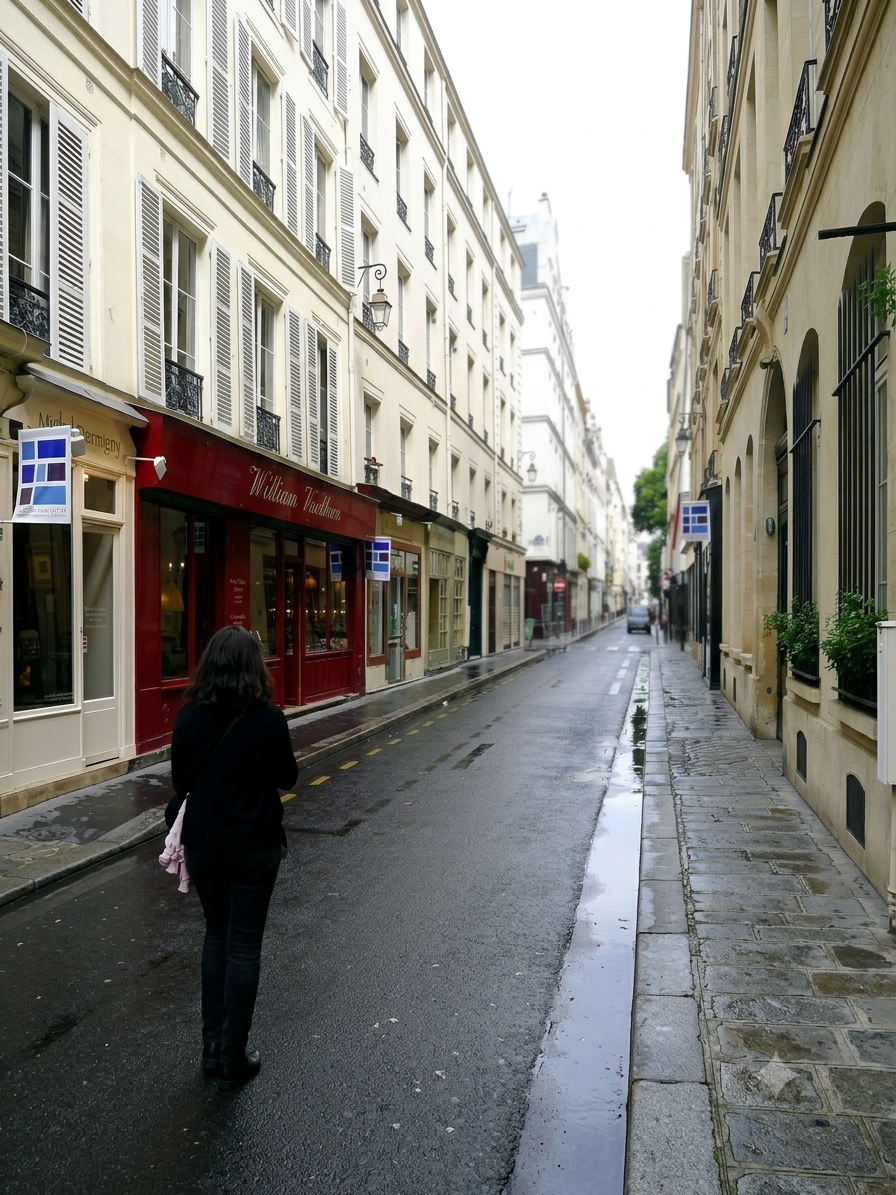
The street of Rue de Verneuil is a picturesque place in Paris. It is known for being part of the 7th arrondissement and connected to the legacy of Serge Gainsbourg, but its cultural significance is what gives this location its unique charm.
The street has a quaint appearance that is often associated with a particular era, but it also has several significant cultural aspects. Someone new to the area would benefit from understanding that its fame extends beyond its architectural characteristics – it has been subject to artistic expression and is recognized by many people around the world.
The street appears on film in various adaptations and is frequently visited by fans of the French singer. This is one of those rare places where you feel like you’re in the heart of Parisian culture. Its allure is linked not only to the beauty of the location but also to the impression created by the presence of a celebrity whose impact still resonates today.
Background Information
The Rue de Verneuil is a street located in the 7th arrondissement of Paris, near the Saint-Thomas-d’Aquin district. This street was built in the 17th century and got its name after Henri de Bourbon-Verneuil, one of the legitimised sons of King Henri IV. Historical details about Henri de Bourbon-Verneuil help explain the origin of the street’s name and its place in French history.
The Rue de Verneuil is comparatively short, stretching for a mere 486 metres from the Rue des Saints-Pères to the Rue de Poitiers. However, this street is famous for being situated in one of the most intellectual and elegant places in Paris, the Left Bank.
The street became popular due to its association with Serge Gainsbourg, who resided in the apartment at number 5 bis from 1969 until his death in 1991. Now the house is considered a shrine and the street is closely associated with the legendary musician and singer. Readers interested in discovering more remarkable places and cultural stories can explore our travel and culture articles.
Why This Matters
Rue de Verneuil is important because it shows how a street can become more than a location. It can become a symbol of memory, identity, and cultural continuity. In Paris especially, streets often carry layers of meaning that connect politics, art, social history, and everyday life
It also matters for anyone interested in how celebrity influence reshapes urban spaces. Gainsbourg’s former home attracted public attention not because it was grand, but because it became emotionally loaded through decades of cultural significance. That makes Rue de Verneuil a useful example of how places gain meaning through people, not just through buildings.
Key Concepts Explained
It seems that the best way to grasp the given narrative is to highlight the several points that the author has made. First of all, the author touches upon the peculiarities of the French street naming system and points out that the names of the streets in Paris may relate to noble families, monarchs, or the city’s past history and heritage. In the case of Rue de Verneuil, the name refers to the French nobility in the past.
The second point is the meaning of the urban space as a place of identity. Thus, Verneuil is not a popular thoroughfare; instead, it is a residential street located in the heart of Parisian luxury and ancient history. The third point lies in the connection between a celebrity’s biography and a location once occupied by him or her. In this case, since the house had been purchased by Gainsbourg, it has become as significant as the man himself and is even considered a part of his biography.
Detailed Walkthrough
If you were walking along Rue de Verneuil for the first time, you would likely notice that it feels understated rather than dramatic. It is described as a long, quiet, conventional street rather than a flashy destination. That quietness is part of its appeal, especially in a city where many famous places are crowded and highly commercialized.
At the entrance from Rue des Saints-Pères, the street leads toward number 5 bis, the famous site connected with Serge Gainsbourg. The exterior wall there became covered with colorful tribute graffiti over time, turning the address into a kind of informal shrine. Visitors can learn more about Serge Gainsbourg’s former home and museum to better understand why this address remains such an important cultural landmark. This is a good example of how public memory can reshape the visual character of a street.
The broader setting also matters. Rue de Verneuil sits in an area associated with antique dealers, galleries, restaurants, and refined residential life. So while the street itself may be calm, it is embedded in a neighborhood with high cultural and real-estate value
Real Examples
A typical example of cultural significance is the house in the fifth street of Verneuil where Gainsbourg lived. In this case, the house became the object of desire for his fans, and the popularity of the address is not the most surprising thing – the transformation of the place where he used to live from a home into a temple of art is more impressive. In turn, another example of the popularity of the street is its use in real estate agents’ data.
In this case, the emphasis is made on the location’s excellent position due to its favorable historical and quiet setting, not only on the fame of a particular person. The third example may seem less relevant to the cultural significance theme, since it refers to the modern fashion world. Nevertheless, the fact that a street name is given to the clothes label symbolizes its associations with Parisian elegance and restraint
Expert Recommendations
I think to understand the true nature of the Rue de Verneuil, one has to approach is as a bi-directional idea, which includes not only the physical location but the cultural and historical context and meaning behind it. You cannot approach it purely from a formal point of view, just by looking at the map, as part of its mystery is hidden in the connection to the specific location. Moreover, if someone is trying to truly engage with it on a deeper level, they have to understand that it is one of the best examples of reverse-engineering of the city’s geography.
With this in mind, I think it is useful to separate the objective and the subjective in this particular instance. By objective, in this case, I mean the straight, formal definition of the Rue de Verneuil. By this, I mean its location, approximate size, and other details pertaining to the description of the area. By the subjective, I mean the associations that this place has in the public consciousness, the symbolic meaning it holds for Gainsbourg, the cultural impact of the graffiti on the walls, and the perceived value of the location in the eyes of Parisian popular culture.
Therefore, in my opinion, the Rue de Verneuil is a perfect example of the concept of place shaping the brand’s value and reverse-engineering the topography. It is crucial to understand the phenomenon for someone who wishes to research the location and truly grasp the meaning behind it, as it is one of the reasons why it became so famous within the cultural niche and was incorporated as a part of the corporate image.
Common Misunderstandings
One common misunderstanding is thinking Rue de Verneuil is famous mainly because it is a tourist landmark. In reality, its fame comes from layered history and from being tied to a major cultural figure, not from being a conventional sightseeing monument. It is more atmospheric than theatrical
Another misunderstanding is assuming the street itself is the same thing as the brand with the same name. They are related only by naming inspiration, not by being the same entity. This matters because search results can mix the street, the house, and the fashion label together.
A third misunderstanding is that important Paris streets must be large, ornate, or crowded. Rue de Verneuil shows the opposite: a quiet street can become iconic when history and culture concentrate there.
Troubleshooting Guide
If you are trying to find the right street, be careful not to confuse Rue de Verneuil with Rue Henri-Verneuil, because these are two different streets. This is a crucial point to understand, and the difference in the spelling can lead to drastically different search results.
Second, if you are skimming the article on the website, you need to differentiate between the information about the street, Gainsbourg’s house, and the brand name. The article covers all of these topics, and they might be easy to confuse with each other.
Finally, if you are analyzing the page for the purposes of writing an essay, remember to focus on the description and the significance of the street. Do not try to simply repeat the information that has already been said. Most interesting articles will have a strong argumentative part that focuses on explaining why something is important rather than simply listing facts about it.
Advanced Tips
For further consideration, the topic of the Rue de Verneuil street can be drawn into the discussion as a part of the urban memory. In fact, it is quite interesting to track the rethinking of the specific significance of this place mediated by time. The change of the area’s meaning is connected precisely with the emergence of a new generation of Gainsbourg fans and the transformation of the neighborhood. In this regard, the Rue de Verneuil can serve for research in the field of cultural studies, as well as for media and urbanistic explorations.
Moreover, the mentioned street can be considered from the point of its reflection in various fields of public discourse. Thus, for instance, it is interesting how the Rue de Verneuil is presented in the writings of heritage commentators, how it is branded in the field of real estate, and how it is recognized and used in other contexts. Additionally, it could be valuable to analyze why certain streets ‘make it big’ due to their famous residents and remain popular after their residents move away while other streets cannot become famous despite years of persistent efforts.
In turn, the current popularity and symbolic value of the Rue de Verneuil is explained mainly by the unique combination of the location, the personalities of its residents, as well as its visual appearance, which was carefully preserved and presented to the public.
Frequently Asked Questions
What is Rue de Verneuil?
It is a street in Paris’s 7th arrondissement, in the Saint-Thomas-d’Aquin area.
Why is it famous?
It is especially known for being the longtime home of Serge Gainsbourg at 5 bis Rue de Verneuil
How old is it?
The street was created in 1640.
Where is it located?
It runs in Paris between Rue des Saints-Pères and Rue de Poitiers.
Is it a tourist attraction?
It is not a major tourist monument in the usual sense, but it has become a place of homage and cultural interest.
Summary
Rue de Verneuil is a street in Paris that has acquired immense popularity, although it is not so long and wide. This place has a great history that dates back to the 17th century. Yet, the main reason for the fame of Rue de Verneuil lies in its connection with Serge Gainsbourg, who lived in one of the houses at that address. Thus, the current popularity of the address of the singer is justified by a long history, unique culture, and celebrity status.
In my opinion, the most essential aspect of this place is that it connects history, culture, and pop-stars with ordinary people. That is why people mention this place in their blogs, articles, and even on real estate sites.